
Explore The Beauty Of Polonnaruwa
Polonnaruwa is a city of elegance, balance, and quiet grandeur—an ancient royal capital where art, engineering, and spirituality reached extraordinary heights. Recognized as a UNESCO World Heritage Site, Polonnaruwa stands as one of Sri Lanka’s best-preserved archaeological treasures, offering visitors a clear and immersive window into the island’s medieval civilization.
Basic Information
Located in Sri Lanka’s North Central Province, Polonnaruwa rose to prominence between the 11th and 13th centuries as the island’s second great capital. Unlike earlier ancient cities, Polonnaruwa reflects a more refined and compact urban design, shaped by strong South Indian influences and a mature Sinhalese architectural tradition.
Today, the city is a carefully conserved archaeological park surrounded by lakes, forests, and open plains. Its calm atmosphere, clear layouts, and exceptional stone craftsmanship make Polonnaruwa one of the most rewarding historical sites to explore in Sri Lanka.
The Rise Of A Medieval Capital
Polonnaruwa became the capital of Sri Lanka after the decline of Anuradhapura, largely due to its more defensible location and access to vital water resources. The city reached its golden age during the reign of King Parakramabahu I, one of Sri Lanka’s greatest rulers, who transformed Polonnaruwa into a powerful political, economic, and religious center.
Under his leadership, massive irrigation works were constructed, palaces and temples flourished, and Buddhist learning was strongly supported. The city that remains today reflects this era of prosperity, order, and artistic excellence.
The Sacred Quadrangle
At the heart of Polonnaruwa lies the Sacred Quadrangle, a compact yet deeply significant religious complex that once served as the city’s spiritual nucleus. Within this area are some of the most refined and symbolically rich structures in the ancient capital.
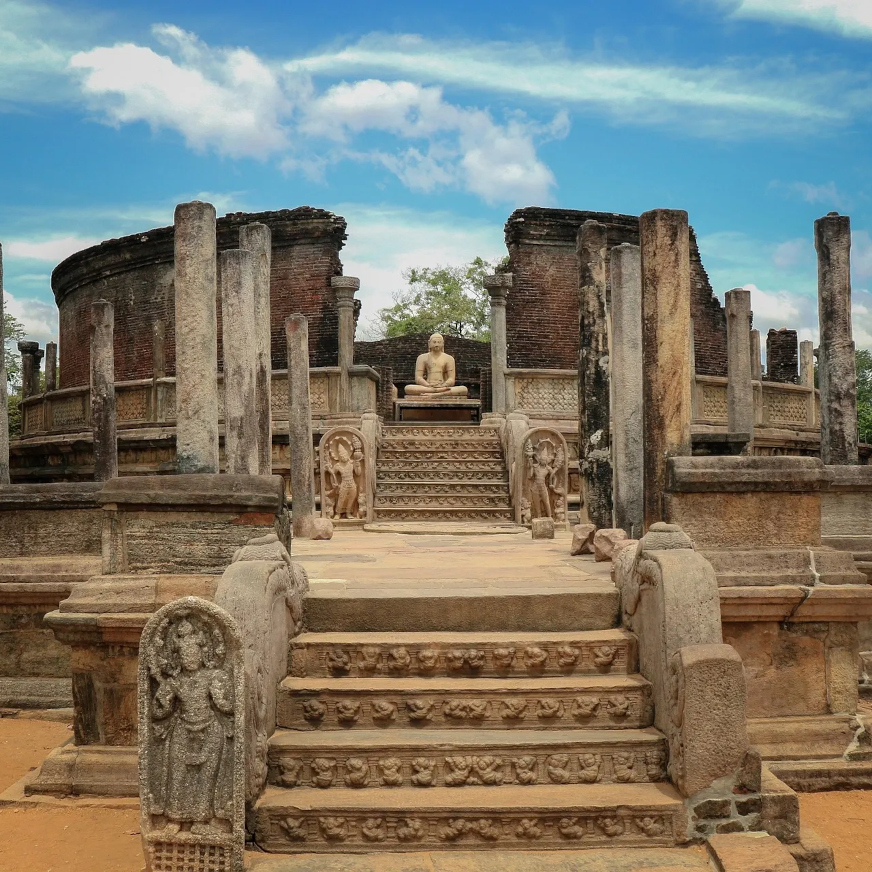
The Vatadage stands out as a masterpiece of stone architecture, built to house a sacred relic of the Buddha. Its circular design, moonstones, and intricately carved guardstones demonstrate a level of craftsmanship rarely matched elsewhere in Sri Lanka.
Nearby, the Hatadage and Atadage served as relic houses, while the Thuparama image house remains one of the best-preserved examples of ancient roofed shrine architecture. Together, these structures reveal the importance of ritual, symmetry, and symbolism in medieval Buddhist worship.
Gal Vihara & Timeless Stone Art
One of Polonnaruwa’s most iconic landmarks is the Gal Vihara, a rock temple featuring four magnificent Buddha statues carved directly into a granite cliff. These figures—a standing, seated, and two reclining Buddhas—are considered the finest examples of ancient Sinhalese rock sculpture.
The calm expressions, flowing robes, and perfect proportions of the statues reflect a deep understanding of both artistic form and spiritual philosophy. Standing before them, visitors often experience a profound sense of stillness and reverence.
Palaces, Monasteries, & Urban Planning
Beyond its religious monuments, Polonnaruwa reveals the sophistication of medieval urban planning. The Royal Palace complex, once a seven-story structure with hundreds of rooms, hints at the power and ambition of its rulers. Nearby, the Audience Hall features exquisitely carved elephants along its base, symbolizing strength and authority.
Monastic complexes such as the Alahana Pirivena illustrate the city’s role as a major center of Buddhist education. These large monastic universities once hosted thousands of monks and scholars, reinforcing Polonnaruwa’s importance as a spiritual and intellectual hub.
Parakrama Samudra & Engineering Genius
A defining feature of Polonnaruwa is the vast reservoir known as Parakrama Samudra. Created under King Parakramabahu I, this immense man-made lake embodies his famous belief that not a single drop of rainwater should be allowed to flow into the sea without serving humanity.
The reservoir not only sustained the city but also supported extensive agriculture across the region. Even today, it remains in use, standing as a lasting testament to the advanced hydraulic engineering of ancient Sri Lanka.
Exploring Polonnaruwa Today
Polonnaruwa’s archaeological sites are spread across a large, flat area, making bicycles one of the best ways to explore the city. Cycling between ruins, shaded by trees and accompanied by birdsong, offers a peaceful and immersive experience unlike any other historical site.
The setting feels open and serene, allowing visitors to appreciate the ruins without crowds or haste. Early morning and late afternoon visits provide soft light and cooler temperatures, ideal for exploration and photography.
Experience Polonnaruwa With Ciao Lanka Tours
At Ciao Lanka Tours, we present Polonnaruwa as a journey into refined ancient living—where spirituality, governance, and artistry coexisted in remarkable harmony. Our guided tours offer historical depth, cultural insight, and effortless travel between key sites.
Whether you are fascinated by stone sculpture, ancient engineering, or the quiet wisdom of the past, Polonnaruwa offers an experience that is both enriching and inspiring.
Walk among royal ruins, witness timeless artistry carved in stone, and rediscover a civilization that valued balance and beauty. With Ciao Lanka Tours, Polonnaruwa becomes more than history—it becomes a living story.